
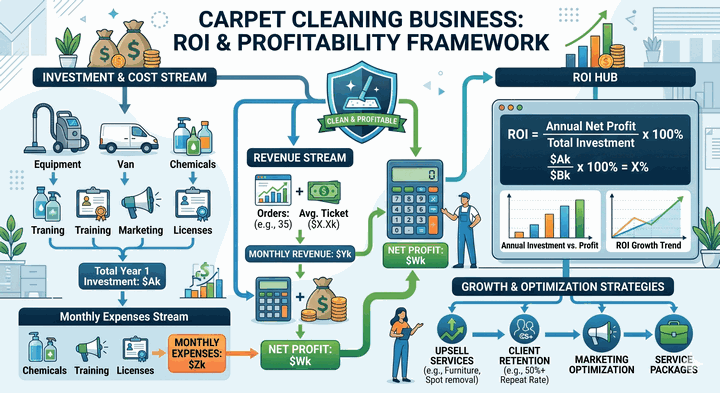
Opening your own carpet cleaning business is an attractive opportunity, but every entrepreneur starts with two questions: "How much can I earn?" and "When will my investment pay off?"
This guide works through real figures: how ROI works in carpet cleaning and how much profit a workshop can realistically make. The numbers are based on real market data and conservative scenarios.
It is a long read, so the main figures are also summarized in one table further down.
What is this guide about?
The guide covers:
- How much money you need to start a carpet cleaning business
- How much you will earn in the first year and beyond
- When your investment will pay off (payback period)
- What your monthly profit will be once the workshop runs at a steady load
- What risks you will face and how to minimize them
We calculated two equipment kits that differ in investment and output.
Who is this for?
- Entrepreneurs who want to start a carpet cleaning business
- Beginners with no experience in this industry
- Anyone who wants realistic numbers instead of optimistic forecasts
- Investors who want to understand the potential of this business
- RWM customers considering buying equipment
Why are our numbers lower than in most business plans?
The problem with most business plans
Real workshops rarely see numbers like these.
Our approach: deliberately pessimistic
- A new business needs a reputation
- Marketing and advertising are needed
- Clients come gradually, not all at once
- Even successful workshops start slowly
- Instead of 1,500 m²/day we count 800 m² (realistic ceiling in year one)
- Instead of 300 m²/day we count 250 m²
- The lower figures allow for breaks, equipment repairs and management time
- Kit 1: starts at 20% load in month 1, +10% each month
- Kit 2: starts at 50% load in month 1, +10% each month
- This is a pessimistic scenario, and your growth may well be faster
- All salaries included (washers + drivers)
- Facility rent included
- Variable costs added (water, electricity, chemicals)
- Insurance, marketing and initial stock of materials included
What did we calculate?
- Equipment
- Conveyor washer + centrifuge + dust beater + finishing machine + rotary machine
- Team
- 3 washers + 2 drivers
- Maximum
- 800 m²/day (realistic ceiling)
- Suitable for
- A full-scale professional workshop
- Equipment
- Centrifuge + rotary machine
- Team
- 3 washers + 1 driver
- Maximum
- 250 m²/day (realistic ceiling)
- Suitable for
- Startups and new businesses
How are the calculations structured?
- Monthly tables (year 1) — volume, revenue, expenses and profit for every month, and the moment the investment pays off
- Key metrics — investment, cumulative profit, ROI in percent, payback period and monthly profit
- 5-year forecast — long-term potential, with 5% annual growth after reaching 100% load
- Comparative analysis — comparison tables of both kits with the pros and cons of each
- Recommendations and strategies — a plain look at the risks and a hybrid strategy: start small, then expand
Main figures (in brief)
| Metric | Kit 1 · 800 m²/day | Kit 2 · 250 m²/day |
|---|---|---|
| Investment | $50,800 | $7,000 |
| Year 1 profit | $199,858 | $45,435 |
| ROI | 393% | 649% |
| Payback period | 6.0 months | 4.3 months |
| 5-year profit | $1,639,774 | $320,787 |
Honest warning
- All equipment prices are real RWM prices
- Salaries are average market rates for the region
- Rent reflects real facility costs
- Cost of $0.15/m² includes water, electricity and chemicals
- Average price of $1.73/m² sits between $1.30 and $2.00
- Load growth is conservative and may be faster in practice
- Your marketing: good advertising means faster growth
- Quality of your work: happy clients recommend you, and referrals cost you nothing
- Premium services such as stain removal, pest treatment and flood restoration
- Long-term contracts with hotels, offices and companies (stable income)
- Efficiency: the faster you work, the higher the profit
- A slow start: 10% load instead of 20% in month one means a loss
- Losing clients to competitors
- Equipment problems: a breakdown can be expensive and delay work
- An unqualified team: poor work leads to bad reviews and lost clients
- A saturated market with many competitors in your area
How to use this guide?
- Don’t trust the figures blindly
- Check they match your market (Almaty, another city?)
- Ask experienced people in the industry
- Rent may be different in your city
- Washers may earn different salaries
- You may attract clients faster, so change the figures to fit your situation
- Choose Kit 1, Kit 2 or the hybrid approach
- Prepare a marketing plan for the first 6 months
- Prepare starting capital and find a good team
- Keep track of income and expenses
- Compare real figures with the forecast
- Adjust your strategy if something is off
Key conclusion
Is it possible? Yes.
An ROI of about 400% and 650% in the first year is a strong result for any business, and payback in 4–6 months is realistic.
Will it be easy? No.
The first months will be:
- Physically demanding (especially with Kit 2)
- Financially tight (small profit)
- Stressful (you need to attract clients)
Is it guaranteed? No.
Success depends on:
- Your ability to work and manage the business
- The quality of your carpet cleaning
- A good team of washers and drivers
- Marketing and promotion of your service
- Choosing the right location with real demand
Hybrid strategy
- Start with Kit 2 ($7,000) to keep the risk low
- Work for 6 months to gain experience and about $15K
- Add Kit 1 equipment ($44K)
- Reach the larger kit's profit without risking the full investment at the start
Next steps
- Study the detailed calculations (PDF below)
- Check real prices in your city
- Consult experienced people in the industry
- Contact RWM to discuss your project
- Develop your business plan based on this guide
Important note
- Real RWM equipment prices (May 2026)
- Average market salaries (Kazakhstan)
- A conservative growth scenario (pessimistic approach)
- An honest analysis of expenses and income
This is not a guarantee of success. It is a planning tool: real results depend on your work, the market, competitors and luck.